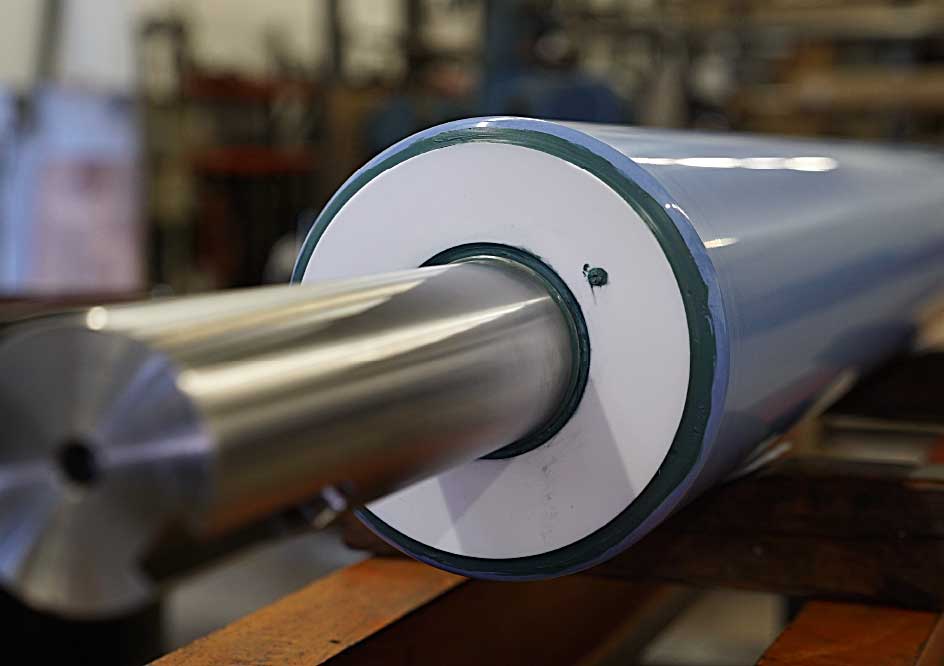
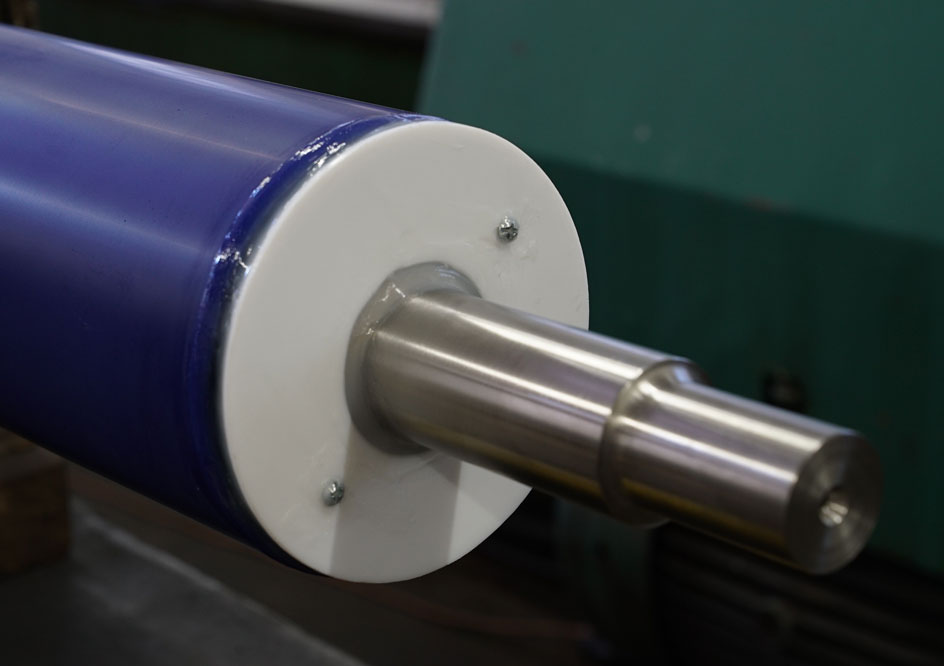

Heat transfer rolls help control web temperature during converting and other continuous manufacturing processes. When temperature is not uniform across the roll face, it can lead to wrinkles, curl, adhesion issues, and product variation. This guide explains what heat transfer rolls do, why temperature uniformity matters, and what to include when requesting a quote.
What Are Heat Transfer Rolls?
A heat transfer roll is a temperature-controlled roller designed to add or remove heat from a moving web. Depending on the process, it may be used as a chill roll, a heating roll, or a conditioning roll.
These rolls are used in converting and web-based manufacturing where temperature affects product quality, dimensional stability, adhesion, and surface finish.
What a Chill Roll Does
A chill roll removes heat from the web. In many lines, it is used to stabilize the material after heat is introduced by extrusion, coating, drying, or heated contact.
When cooling is consistent, the web behaves predictably. When cooling is uneven, the web can change shape or properties across its width, which shows up later as defects or variability.
Why Uniform Temperature Matters
Uniform temperature across the roll face matters because the web is continuous. Any temperature difference across the width can create differences in material behavior across that same width.
Depending on your process, non-uniform temperature can contribute to problems like:
- Wrinkles and handling instability
- Thickness and quality variation across the web
- Uneven coating or drying results
- Curl and dimensional changes
- Adhesion variability in laminating and bonding steps
If you are fighting “mystery” variation that comes and goes, temperature profile is a common place to look.
Where Non-Uniform Temperature Comes From
Several real-world factors can lead to temperature variation across the roll face:
- The internal flow path does not distribute heating or cooling evenly
- Deposits or contamination reduce heat transfer in specific zones
- The web does not cover the full roll face, so heat is removed only where the web contacts
- Changes in line speed, tension, or wrap angle change heat transfer conditions
Uniform temperature is not only about the setpoint. It is about how well the roll maintains a consistent surface profile during real production.
Heat Transfer Roll Quote Checklist
If you are requesting a new heat transfer roll or a replacement, here is the information that helps engineering and quoting move quickly:
- Application: chill roll, heating roll, or thermal conditioning
- Web material and thickness range
- Web width and typical coverage of the roll face
- Line speed range
- Target web temperature in and out of the roll
- Process conditions that add heat before the roll (dryers, extrusion, coating, heated contact)
- Roll diameter and face length
- Journal dimensions and bearing details
- Allowed runout and surface finish requirements
- Heat transfer medium: water, oil, or other
- Available supply and return temperatures
- Available flow rate and pressure limits
- Any known issues today: wrinkles, curl, adhesion problems, or cross-web variation
Request a Quote
If you are seeing temperature-related variation or want to improve stability and product quality, send your roll specs and process details.
We will review your application and recommend the best next step.