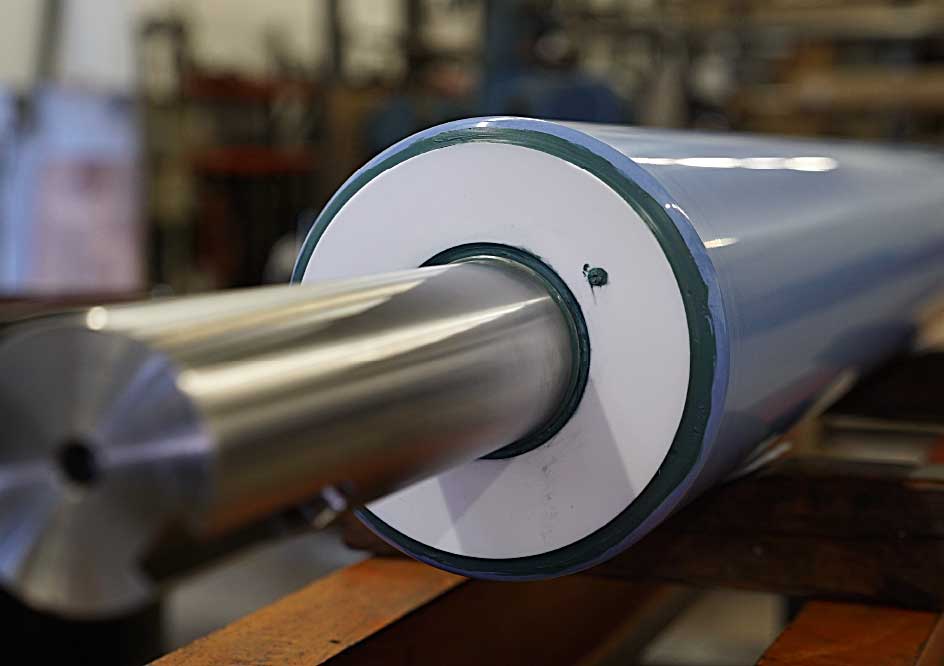
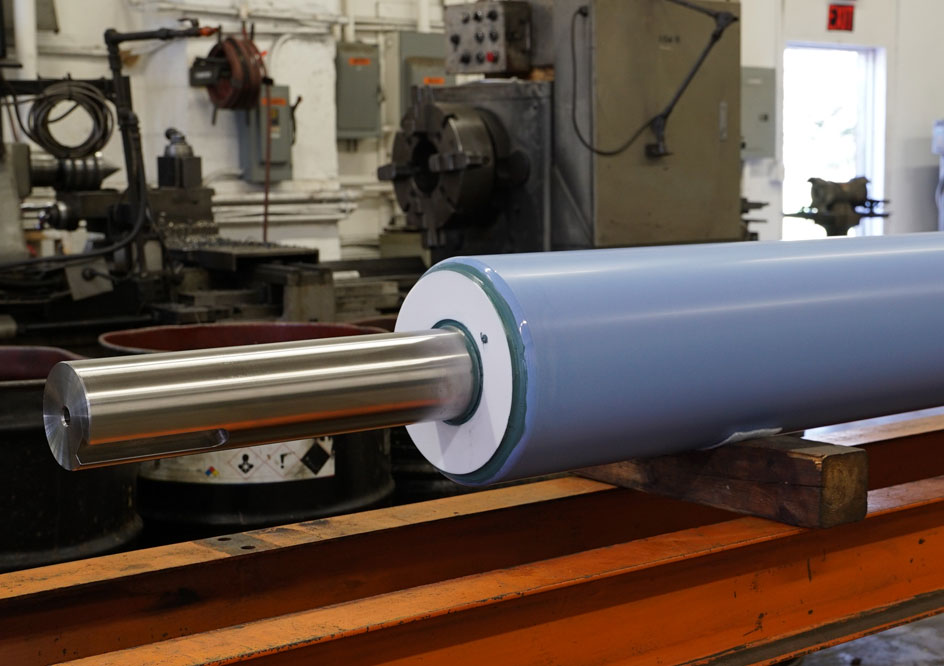

Bath rollers and squeeze rollers play a major role in pickup control, wetting, and uniformity in sizing lines. When roll surfaces change from chemical attack, abrasion, or build-up, the result is often cross-web variation, streaks, or unstable pickup. This guide explains what these rolls do, what usually goes wrong, and how to think about surface selection.
Sizing lines are simple on paper: run a web through a bath, control pickup with squeeze rolls, dry, and move on. In reality, small changes in roll surface condition can create big swings in pickup, uniformity, and finished quality.
This post covers what bath rollers and squeeze rollers do, what usually goes wrong, and how to think about surfaces when the process includes chemicals and abrasion.
What Bath Rollers and Squeeze Rollers Do in a Sizing Line
Bath rollers (also called dip rollers) run in or through the sizing bath. Their job is to guide the web through the solution and help deliver consistent wetting and contact.
Because they live in the bath environment, they face constant exposure to:
- Chemical attack from the bath solution
- Temperature cycling
- Continuous wet operation
- Build-up and deposits
- Abrasion from fillers, fibers, or particulates
A bath roller that slowly changes surface condition can quietly change how the web wets and how evenly the bath is carried into the nip.
What Squeeze Rollers Actually Control
Squeeze rollers control what stays on the web after the bath. That “what stays on” becomes your coating weight, resin add-on, or pickup level.
When the squeeze nip is stable and uniform, pickup is stable and uniform.
When something changes in the nip, you often see:
- Cross-web pickup variation
- Edge-heavy pickup
- Streaks or bands
- Wet spots and dry spots
- Run-to-run drift with no obvious process change
In many lines, the squeeze section is where surface problems first show up as quality problems.
Why Surfaces Matter More Than People Expect
In sizing lines, the roll surface is doing multiple jobs at once:
- Resisting chemical exposure
- Maintaining friction and grip characteristics
- Staying dimensionally stable under load
- Allowing consistent wet release and transfer
- Staying cleanable without degrading
If the surface swells, softens, pits, or gets rougher over time, your nip behavior changes. If the surface gets polished, glazed, or loaded with deposits, pickup changes again.
Even if your setpoints stay the same, your results won’t.
The Two Enemies: Chemical Attack and Abrasion
Chemical attack
Bath chemistry can attack certain metals, elastomers, and coatings. Over time this can lead to:
- Surface softening
- Swelling
- Cracking
- Delamination from the core
- Pitting or corrosion of the base material
Abrasion
Sizing baths often contain fillers, fibers, or particulates. Web contact and nip pressure can turn those into an abrasive environment that:
- Wears the surface
- Changes roughness
- Changes diameter
- Creates uneven zones across the face
Once diameter or roughness changes across the roll, pressure distribution changes across the nip. That’s when you get cross-web variation that is hard to tune out.
Common Signs the Roll Surface Is Driving Variability
If you see any of these, it’s worth evaluating the bath and squeeze roll surfaces:
- Pickup variation across the web width
- A steady drift in pickup over time
- Increasing edge-heavy pickup
- Streaks that don’t match the bath circulation pattern
- Frequent build-up that returns quickly after cleaning
- Shortening time between regrinds or recoverings
- Unexplained increases in nip pressure to “get the same result”
A lot of “process problems” are really “surface problems.”
What Usually Causes Uneven Pickup in the Nip
These are the big repeat offenders:
- Uneven roll wear across the face
- Hardness changes from chemical exposure
- Deposits that create localized high/low pressure
- Surface glazing that changes wet release
- Roll deflection that isn’t being compensated for
- Misalignment, runout, or bearing issues that show up as streaking
If your nip is not uniform, your pickup won’t be uniform.
How to Think About Surface Selection
A good sizing-line surface should be selected based on:
- Chemical compatibility with the bath and cleaning agents
- Abrasion resistance based on fillers/particulates and web type
- Hardness needed to hold shape under load
- Required friction and wet release behavior
- Finish requirements tied to pickup and uniformity goals
- Maintenance approach and how often the line can tolerate service
There is no single “best” surface. The right surface is the one that stays stable in your environment.
Spec Checklist for Bath and Squeeze Roll Quotes
If you want a fast, accurate recommendation, send:
- Line type and process goal (sizing, resin pickup, chemical treatment)
- Bath chemistry and concentrations if available
- Operating temperature range
- Web material and thickness range
- Line speed range
- Web width and typical coverage across the roll face
- Target pickup or add-on range
- Current roll construction and surface type
- Cleaning agents and cleaning method
- Nip pressure range and any deflection compensation method
- Roll diameter, face length, and journal/bearing details
- The specific failure mode you’re seeing (build-up, swelling, wear, streaks, corrosion)
The more specific you are about the chemistry and failure mode, the faster the right surface choice becomes obvious.
Request a Quote or Surface Review
If you’re seeing corrosion, abrasion wear, build-up, or inconsistent pickup in a sizing line, send your roll specs and process details. We’ll review the application and recommend the next step for a more stable surface and more consistent results.