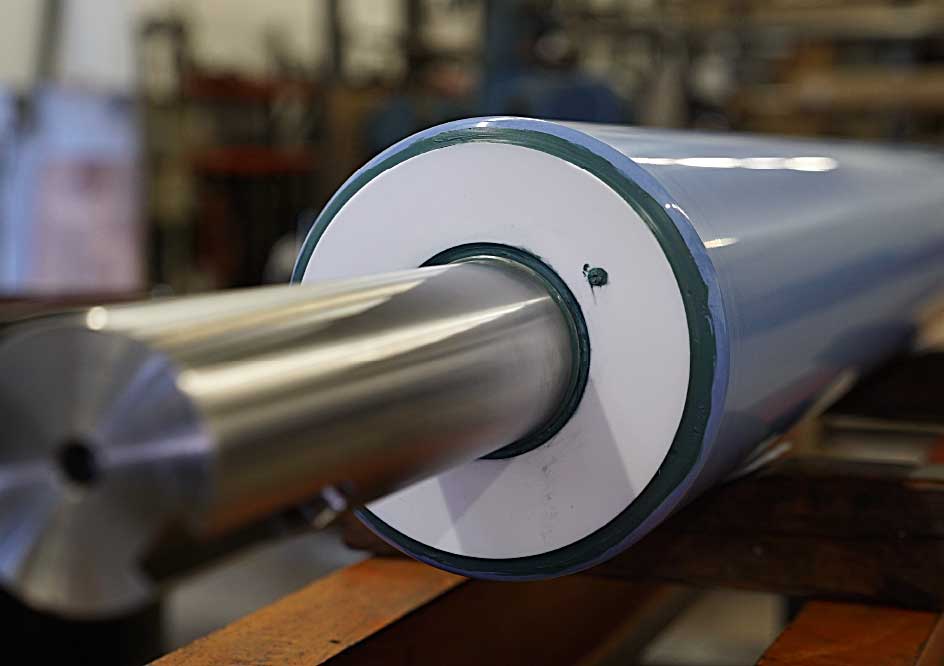


Release coatings help reduce sticking, lower friction, and improve cleanability in converting and web processes. This guide explains how to specify release coatings based on failure mode, operating environment, surface finish, and mechanical requirements.
Release coatings get talked about like they’re a single thing: “We need a non-stick roll.” But in converting and web processes, “non-stick” can mean very different problems.
This post is a practical guide to specifying release coatings so you get the right mix of low friction, easy release, durability, and chemical/temperature resistance.
What Release Coatings Do
A release coating is used on rollers to reduce sticking, reduce friction, and keep materials moving consistently through a process.
Common reasons plants spec release-coated rollers:
- Adhesives sticking to idlers or nips
- Hot materials softening and transferring to the roll
- Resin or coating build-up that becomes downtime
- Film or web scuffing due to friction
- Blocking, picking, or tearing at contact points
A good release surface stabilizes the process. A poor one turns into a constant cleaning and maintenance cycle.
Step 1: Define the Failure Mode You’re Preventing
Before you pick a coating family, you want to answer one question:
What is sticking and why?
Common modes:
- Adhesive transfer: pressure-sensitive adhesives, hot melts, tacky coatings
- Thermal tack: hot web or molten surface softening and smearing
- Resin build-up: coating chemistry depositing on the roll face
- Friction scuffing: web damage from sliding contact
- Contamination + cleanup: frequent cleaning cycles degrading the surface
Different problems point to different surface choices.
Step 2: Know the Operating Environment
Release coatings succeed or fail based on conditions.
You should specify:
- Temperature at the roller surface (normal and peaks)
- Chemical exposure (solvents, plasticizers, cleaners, vapors)
- Mechanical load (nip pressure, wrap angle, tension)
- Abrasive content (fillers, powders, pigments, dust)
- Cleaning routine (chemistry + frequency + method)
If you skip this, you’ll get a surface that releases well at first, then degrades fast.
Step 3: Choose the Right Coating Family for the Job
Most release rollers fall into a few common categories. Each has tradeoffs.
Fluoropolymer release coatings
Often selected when you need strong non-stick and low friction.
Typical options include PTFE, FEP, and PFA families.
General tradeoffs:
- PTFE: very low friction and strong non-stick, great for many applications
- FEP: can form smoother, less porous films and can be useful where chemical resistance and smoothness matter, but typically lower max temperature than PTFE/PFA
- PFA: can combine high temperature capability with a smoother, less porous film and can be built thicker for toughness in some builds
The right choice depends on your temperature, chemistry, and wear profile.
Silicone release surfaces
Often used when you need easy release against certain adhesive systems and want a compliant surface.
Tradeoffs:
- Can be excellent for release in specific adhesive scenarios
- Can be more sensitive to certain solvents, temperatures, or abrasion depending on the build
Hard, wear-resistant surfaces with release behavior
In some lines, “release” problems are really “wear and build-up” problems.
If abrasion is the driver, you may need a more wear-focused surface approach, potentially paired with a release top layer or a finish designed to reduce adhesion.
Step 4: Specify the Surface Finish You Need
Surface finish matters as much as coating chemistry.
In release applications, finish affects:
- How easily material releases
- Build-up tendency
- Slip vs traction
- How fast the surface wears or glazes
- Cleanability
A smoother finish can reduce mechanical anchoring of sticky materials. But in some processes, too smooth can create slip issues or tracking issues.
You should specify the finish target that matches your process goals, not just “non-stick.”
Step 5: Don’t Forget the Mechanical Requirements
Release coatings aren’t used in a vacuum. The roll still has to run true, hold geometry, and survive the load.
Make sure you specify:
- Roll diameter and face length
- Journal dimensions and bearing fits
- Runout limits
- Nip pressure range if it’s a squeeze or nip roll
- Wrap angle or contact conditions
- Expected service interval goals
A coating that releases well but wears through in weeks is not a release solution. It’s a recurring maintenance plan.
Spec Checklist: What to Send When Requesting a Quote
If you want a release coating recommendation that works long-term, send:
- What is sticking or building up, and where in the line
- Web material and thickness range
- Line speed and tension range
- Roller position and contact conditions
- Temperature at the roll surface, including peaks
- Coating, adhesive, resin, or chemical exposure
- Abrasive content, dust, or fillers present
- Cleaning chemicals used and cleaning frequency
- Desired result: reduced build-up, reduced friction, improved release, longer run time
- Roll diameter, face length, journal details, and runout requirements
- Any current surface type and what is failing about it
The fastest path to the right coating is a clear description of the failure mode plus the environment.
Talk to an Engineer
If you’re dealing with sticking, build-up, or friction problems on your line, send your roll specs and process details. We’ll review the application and recommend a release surface that matches your temperature, chemistry, and wear conditions.